
Fertilization
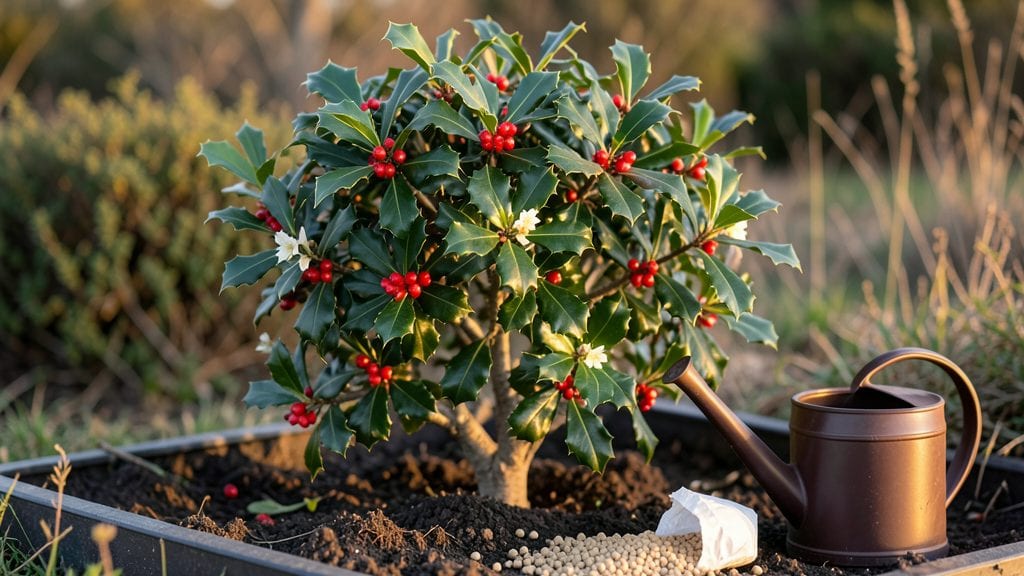
Choosing the right holly tree fertilizer is the secret to keeping its glossy leaves and bold berries thriving all season long.
Struggling to keep your holly tree lush and vibrant year-round? The right fertilizer can transform its growth—if you get the soil pH and nutrient ratios just right.
Holly trees thrive when their soil stays slightly acidic, between 4.5 and 6.0, and packed with balanced nitrogen, phosphorus, and potassium. Too much fertilizer can burn roots, while too little leaves your tree looking tired and sparse.
In this guide, I’ll walk you through the best organic and synthetic fertilizers, when to apply them, and how to read your tree’s signals to keep it healthy—no guesswork required.

Optimal soil pH and nutrient ratios for holly tree fertilizer
Your holly tree thrives when its soil pH and nutrient ratios are perfectly balanced. The right conditions unlock vibrant foliage, stronger branches, and those prized holly berries.
Without proper fertilization, you’ll see stunted growth or pale leaves—even if you’re watering correctly. Let’s break down the science behind what your holly truly needs to flourish.
Holly trees prefer an acidic to slightly acidic soil with a pH range of 4.5 to 6.0. Most garden soils fall outside this range, which is why testing your soil is the first critical step.
If your pH is too high (alkaline), nutrients like iron and manganese become unavailable, causing yellowing leaves—a classic sign of nutrient deficiency. Adjusting pH with sulfur or peat moss can make a world of difference.
Now, let’s talk nutrient ratios. Holly trees respond best to a balanced fertilizer with an NPK ratio of 10-10-10 or 12-4-6. The first number (nitrogen) promotes leafy growth, while phosphorus (the second number) supports root development and berry production.
Potassium (the third number) strengthens disease resistance and overall plant vigor. A 10-10-10 ratio is ideal for general health, but a 12-4-6 blend can encourage more berries if that’s your goal.
Micronutrients are equally important. Holly trees often lack iron and magnesium, which can lead to chlorosis (yellowing between leaf veins). A soil test will reveal deficiencies, but you can also apply chelated iron or Epsom salt (for magnesium) as a quick fix.
These elements are crucial for photosynthesis and energy production in your tree’s leaves.
summary-table
Seasonal adjustments are key to keeping your holly tree healthy year-round. In early spring, focus on nitrogen to kickstart growth after winter dormancy. By late spring to summer, switch to a lower-nitrogen, higher-phosphorus fertilizer (like 6-12-6) to support berry development.
In fall, a potassium-rich blend (e.g., 5-10-15) helps harden off the tree for winter. Avoid fertilizing in winter—your holly is dormant and won’t benefit from nutrients.
Over-fertilizing is a common mistake that can burn roots and damage your tree. Always follow the recommended application rates on fertilizer labels, and water thoroughly after applying. For young holly trees, start with half the recommended dose to avoid shocking their delicate root systems.
Mature trees can handle full-strength applications, but even they benefit from a light feeding every 6-8 weeks during the growing season.
Organic options like composted manure, worm castings, or fish emulsion are excellent for holly trees, as they improve soil structure and provide slow-release nutrients. If you prefer synthetic fertilizers, look for slow-release granules or liquid feeds designed for acid-loving plants.
Both types work well, but organic choices are gentler on the environment and build soil health over time.
Pay attention to your holly
Best organic vs. synthetic fertilizers for holly trees
Choosing the right holly tree fertilizer depends on your gardening goals—whether you prioritize long-term soil health or immediate growth boosts. Holly trees thrive with a balanced 10-10-10 NPK ratio, but the delivery method matters just as much.
Organic options like compost and worm castings enrich soil over time, while synthetic fertilizers offer quick nutrient uptake. Let’s break down the pros and cons to help you decide.
I’ve tested both approaches in my own garden, and the results speak volumes. Organic fertilizers improve soil structure and microbial activity, but they require patience. Synthetic options deliver fast results but can disrupt the natural ecosystem if overused.
Your choice should align with your holly tree’s needs and your commitment to sustainable gardening.
Organic Fertilizers for Holly Trees
- Improves soil health over time
- Slow-release nutrients reduce burn risk
- Eco-friendly and sustainable
- Worm castings add beneficial microbes
- Slower results compared to synthetics
- Requires preparation (e.g., composting)
- May need supplemental nutrients for quick fixes
Synthetic Fertilizers for Holly Trees
- Fast nutrient delivery for rapid growth
- Precise NPK ratios tailored to holly needs
- Easy to measure and apply
- Slow-release granules minimize over-fertilization
- Can disrupt soil microbes long-term
- Risk of burning roots if overapplied
- Less environmentally friendly
For organic options, I recommend fish emulsion (like Neptune’s Harvest) for a quick nitrogen boost, or composted manure for long-term benefits. These work wonders for established holly trees needing a nutrient recharge. Brands like Espoma offer organic holly-specific blends with micronutrients like iron and magnesium, which holly trees crave.
Synthetic fertilizers shine when you need immediate results. Slow-release granules like Miracle-Gro Shake ’n Feed (12-4-6) are my go-to for spring feeding. They’re easy to apply and dissolve evenly, reducing the risk of fertilizer burn.
For liquid options, Jack’s Classic (10-10-10) is a balanced choice that dissolves instantly, perfect for container-grown hollies.
Cost-wise, organic fertilizers like worm castings ($15–$30 per bag) or compost ($10–$20 per cubic yard) are an upfront investment, but they pay off in soil health. Synthetics like Miracle-Gro granules ($10–$20 per bag) are cheaper per application but may require more frequent use.
If you’re eco-conscious, organic wins; if you need quick results, synthetics deliver.
Pro tip: Mix both approaches! Use organic compost as a base and top-dress with a slow-release synthetic in early spring. This gives your holly the best of both worlds—long-term soil vitality and immediate growth support. 🌿