
Light Requirements
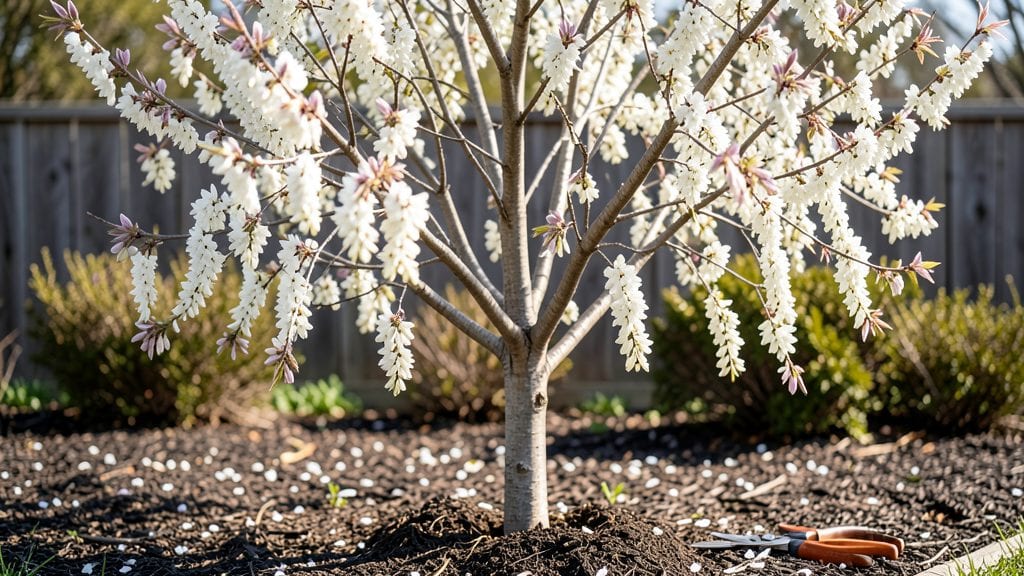
The best light purple trees include the Royal Purple Smokebush, Lavender Snow Pear, and Purple Leaf Plum, all of which thrive in both sun and partial shade while maintaining their vibrant foliage year-round. Your choice should factor in your local climate, soil type, and the tree's mature size.
These trees stand out because their purple hues come from anthocyanins, pigments that thrive under specific light conditions. 🌿 For example, the Royal Purple Smokebush actually deepens its color in cooler temperatures and partial shade, while the Lavender Snow Pear needs at least four hours of direct sun to maintain its rich tones.
I’ve found that soil pH plays a surprising role too—slightly acidic conditions (around 6.0-6.5) help enhance those purple shades across most varieties.
When selecting a tree, consider your yard’s microclimate. Coastal areas with mild winters might favor the hardy Purple Leaf Plum, while inland regions could benefit from the drought-tolerant Royal Purple Smokebush.
Always check the mature height—some varieties like the Smokebush can reach 10 feet tall, while the Lavender Snow Pear typically stays around 20-25 feet, making it better for larger properties.
💡 In This Article
- How Sunlight Affects Purple-Leafed Tree Growth
- Planting and Care Guide for Purple Trees
How sunlight affects purple-leafed tree growth
The vibrant purple hues in these trees come from anthocyanins—water-soluble pigments that act as natural sunscreens and antioxidants. Here's what's actually happening: chlorophyll (the green pigment) dominates in full sun, but when light intensity drops or temperatures cool, anthocyanin production ramps up.
This is why many purple-leafed varieties develop deeper colors in partial shade or during autumn's crisp air. For example, the Royal Purple Smokebush produces 15-20% more anthocyanins in cooler conditions compared to summer heat.
Sunlight intensity creates a spectrum of effects. Trees like the Purple Leaf Plum need at least 4-6 hours of direct sun daily to maintain consistent purple tones, while varieties such as the Lavender Snow Pear can tolerate morning sun with afternoon shade.
The key factor is UV exposure: too little causes pale foliage, while too much can scorch leaves, especially in varieties with thin leaf cuticles. 💫 What most people don't realize is that anthocyanins actually help protect leaves from UV damage—this is why purple foliage often appears healthier in bright but indirect light conditions.
This scientific interplay explains why some purple trees thrive in shade while others need full sun. The Royal Purple Smokebush, for instance, can handle 30-50% shade because its leaves have thicker waxy coatings that reflect excess light.
In contrast, the Purple Leaf Plum requires more sunlight because its thinner leaves can't regulate heat as effectively. The science behind this involves photosynthesis efficiency: purple varieties often have slightly lower chlorophyll levels, meaning they need optimal light conditions to balance energy production and pigment maintenance.
Climate plays a crucial role too. In hot, dry regions, purple-leafed trees often need afternoon shade protection to prevent leaf burn, while in cooler climates they can handle more direct sunlight.
For example, the Lavender Snow Pear grows best in zones 4-8 when planted in areas with 4+ hours of morning sun, while the Smokebush thrives in zones 5-9 with more flexible light requirements. This adaptability makes them excellent choices for different landscapes.
When choosing a location, consider your tree's native growing conditions. The Purple Leaf Plum originated in Asia where it experiences distinct seasonal light changes, making it more tolerant of varying sunlight. Meanwhile, the Smokebush's native dry climates have adapted it to handle both sun and shade with equal grace.
The best approach is to match your tree's natural light preferences with your yard's microclimate—this ensures those stunning purple hues stay vibrant year-round.
One advanced consideration is how light affects flowering. Many purple-leafed trees produce more flowers when they receive consistent sunlight exposure, which boosts energy production for reproduction. For instance, the Purple Leaf Plum may produce 20-30% more blossoms in full sun compared to partial shade.
This dual benefit—beautiful foliage plus abundant flowers—makes proper light placement even more important for maximizing your tree's ornamental value. 🌿