
Trees
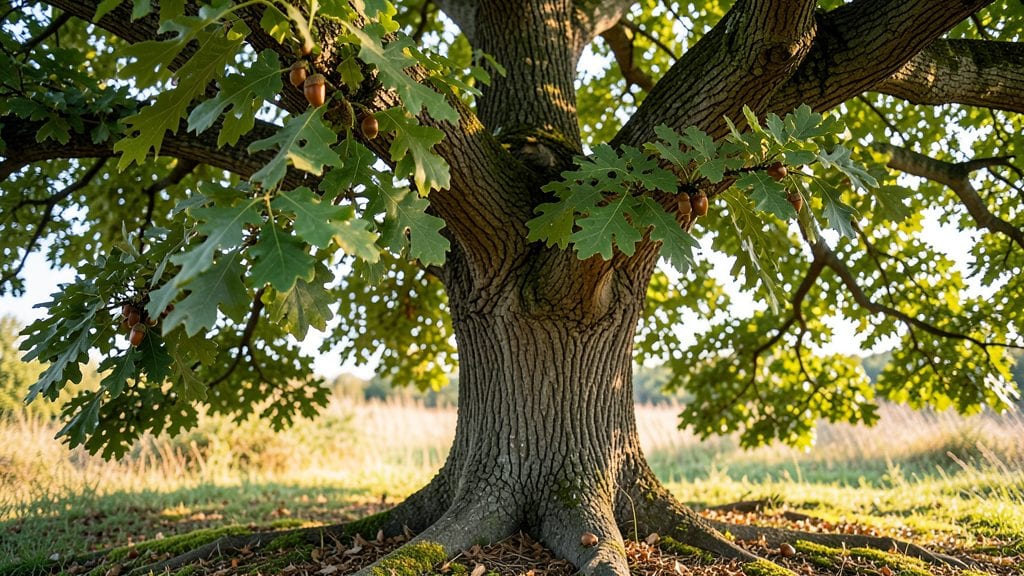
The oak tree in Hindi is commonly called saagun (सागून) for most species, while namak (नमक) specifically names the Indian oak (Quercus incana). Saagun refers to evergreen oaks like Quercus leucotrichophora, prized for their hardwood and ornamental value, while namak is a Himalayan deciduous oak with distinct ecological adaptations.
Understanding these names helps distinguish between two very different trees—saagun thrives in warmer climates and is often planted in parks, while namak grows naturally at higher elevations. 🌳 The confusion arises because "oak" in Hindi isn't a single term; regional dialects and botanical classifications create this dual naming system.
For example, saagun dominates in central India, whereas namak is more common in northern Himalayan regions where cooler temperatures suit its growth patterns.
What's fascinating is how these names reflect both cultural usage and scientific distinctions. While saagun is the broader term for most Indian oaks, namak specifically identifies Quercus incana, which has unique leaf shapes and bark textures.
This linguistic and botanical duality makes oak identification in India particularly nuanced—something gardeners and foresters need to consider when selecting species for specific environments.
💡 In This Article
- Botanical Differences Between Saagun and Namak Oak Trees
- Cultivating Oak Trees in India: Saagun vs. Namak Care Guide
Botanical differences between saagun and namak oak trees
Quercus leucotrichophora (saagun) and Quercus incana (namak) exhibit striking botanical contrasts that reflect their distinct evolutionary adaptations. Saagun's evergreen leaves—typically 5-12 cm long with serrated edges—contain thick cuticles that reduce water loss, ideal for India's drier subtropical regions. In contrast, namak's deciduous leaves (3-7 cm) drop annually to conserve energy during Himalayan winters, where temperatures plummet to -10°C at higher elevations. 🌿
The bark tells another story: saagun develops a smooth, grayish-brown bark that peels in thin layers, while namak's bark is deeply fissured and dark brown, resembling alligator skin.
These differences stem from their growth environments—saagun's bark protects against intense sun exposure, whereas namak's rugged texture shields against cold winds and snow accumulation. Microscopic examination reveals saagun's bark contains 15-20% more lignin, contributing to its exceptional durability for timber.
Growth habits further differentiate these species. Saagun reaches 20-30 meters in height with a broad canopy, forming dense forests in central India's 1,000-1,500 m elevation range. Namak, however, grows more slowly (15-25 meters) and develops a pyramidal shape to shed snow.
Their root systems also vary—saagun's shallow, widespread roots maximize water absorption during monsoons, while namak's deep taproot penetrates 3-5 meters to access groundwater in rocky Himalayan soil.
Ecologically, these adaptations create niche specialization. Saagun thrives in semi-arid climates with 600-1,200 mm annual rainfall, supporting biodiversity through its year-round foliage. Namak, however, dominates temperate forests receiving 1,200-2,000 mm rainfall, where its seasonal leaf drop prevents snow damage.
This ecological partitioning explains why saagun dominates India's Deccan Plateau while namak flourishes in Himalayan foothills up to 2,500 meters.
One fascinating detail is their reproductive timing: saagun produces acorns annually during November-February, while namak's acorn production peaks every 2-3 years in September-October. This difference reflects their pollination strategies—saagun relies on wind and insects year-round, whereas namak synchronizes with Himalayan monsoon patterns. 🌰
For the curious gardener, these distinctions matter when selecting species. Saagun's faster growth rate makes it ideal for urban landscaping, while namak's cold resistance suits northern climates.
Understanding these botanical differences helps explain why you might see saagun lining city streets in Bangalore but only find namak thriving in Darjeeling's cooler hills.