
Companion Plants
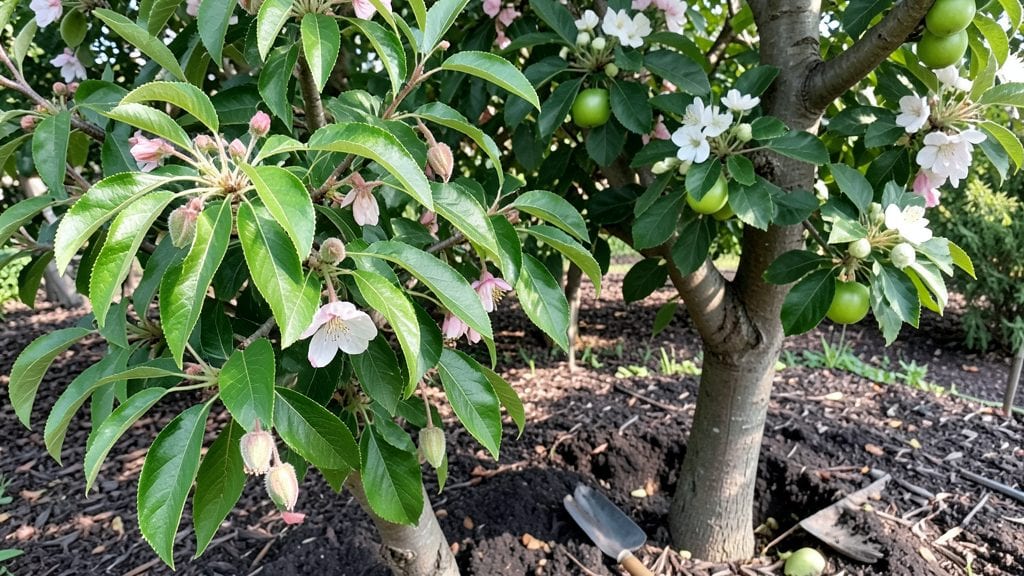
Peach trees cannot pollinate apple trees because they belong to different botanical families (Prunus for peaches, Malus for apples), meaning their flowers lack compatible pollen structures and genetic compatibility for successful fertilization. Cross-pollination between these species is biologically impossible.
A peach tree's flowers simply won't recognize apple tree pollen—and vice versa—because their reproductive systems evolved independently over millions of years. 🌱 The Prunus family (peaches, plums, cherries) and Malus family (apples, crabapples) developed distinct pollen structures, so even if pollen lands on the wrong flower, fertilization won't occur.
This genetic mismatch explains why orchardists carefully select compatible varieties when planning fruit tree pairings.
What this means for your garden: if you're planting both trees, you'll need separate pollinators for each. Peaches thrive with other stone fruits like plums or nectarines, while apples pair best with other Malus varieties. The good news? Both types benefit from bees and other pollinators—just not each other.
💡 In This Article
- Botanical Differences Between Peach and Apple Trees
- Best Fruit Tree Pollination Pairings for Your Garden
Botanical differences between peach and apple trees
The fundamental barrier to cross-pollination lies in their family classification within the Rosaceae family. Peach trees belong to the Prunoideae subfamily, while apple trees fall under Maloideae. This separation means their genetic material has diverged significantly over evolutionary time—about 10-20 million years—resulting in incompatible reproductive structures.
Even if pollen transferred, the biochemical signals required for fertilization wouldn't align. 🌿
Flower morphology presents another critical obstacle. Peach blossoms have 10 stamens with prominent anthers that release pollen in a specific pattern, while apple flowers typically have 20 stamens with differently structured pollen grains.
The pistil (female reproductive part) in each species also varies in size and chemical composition—peach pistils are 1-2 mm longer than apple pistils, with incompatible stigma surfaces for pollen adhesion. This structural mismatch prevents pollen tubes from growing down the style to fertilize ovules.
At the cellular level, the issue becomes even clearer. Apple pollen contains two sperm cells (a characteristic of the Maloideae subfamily), while peach pollen contains three (typical of Prunoideae).
When fertilization occurs, the extra sperm cell in peach pollen would create a genetic imbalance in apple ovules, resulting in failed embryo development. This ploidy mismatch is a common barrier between distantly related plant species. 🔬
Consider this practical analogy: trying to fit a square peg (peach pollen) into a round hole (apple pistil). The physical and biochemical incompatibility extends beyond just size—it involves complex molecular recognition systems that evolved separately.
Even if you could force pollen transfer in a lab setting, the resulting hybrid would likely be sterile due to these fundamental genetic differences.
For visual clarity, imagine comparing a daisy flower (composite family) to a rose (also Rosaceae but different subfamily). While both share some basic floral structures, their reproductive systems remain fundamentally distinct. This is why botanists classify them separately despite superficial similarities in leaf shape or growth habits.
The evolutionary divergence explains why orchardists never attempt cross-pollination between these species. Instead, they focus on intra-family pollination, where peaches pair with plums or nectarines, and apples pair with other Malus varieties. This strategic approach ensures successful fruit set while maintaining genetic compatibility across generations. 🌳