
Companion Plants
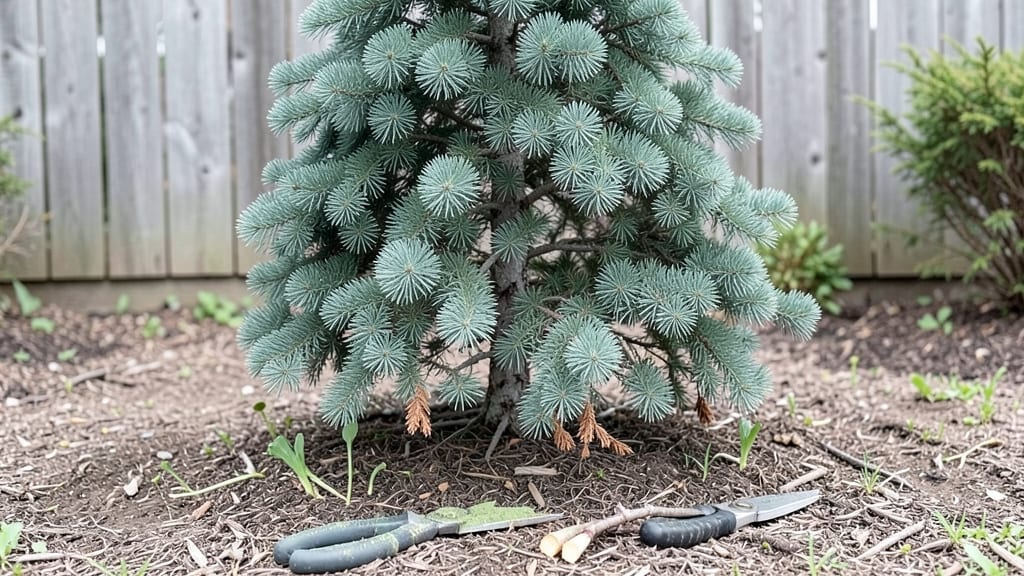
You can cut the top off an evergreen tree, but this drastic pruning—called topping—must be done cautiously to prevent stress, disease, or pest damage. Never remove more than 25% of the foliage at once, and always use sharp tools for precise cuts.
Topping an evergreen disrupts its natural growth hormones, which can lead to weak, unsightly regrowth or even death if done incorrectly. 🌲 Different species handle this differently—pines might produce "candelabra" growth while spruces often struggle to recover.
The best approach is selective pruning instead of heavy topping, focusing on shaping rather than removing large sections.
For those who must top, timing matters: late winter or early spring (just before new growth) is ideal. Always sterilize tools between cuts to prevent bacterial infections, and seal larger wounds with pruning sealant. Remember, most evergreens recover better from gradual shaping than from aggressive topping.
💡 In This Article
- How Topping Affects Evergreen Tree Health
- Safe Pruning Techniques for Evergreen Trees
How topping affects evergreen tree health
When you remove the top of an evergreen tree—called topping—you're essentially severing its hormonal communication system. The apical bud at the crown produces auxin, a growth hormone that regulates vertical growth and suppresses side branches.
Without it, lateral buds awaken chaotically, leading to dense, weak regrowth that's prone to breakage. Pines often develop "candelabra" growth, while spruces may produce unsightly, bushy clusters that block sunlight from lower branches.
The vascular system takes a hit too. Evergreens rely on a specialized transport system to move water and nutrients from roots to needles. Removing the crown disrupts this flow, causing water stress that can lead to needle browning or dieback.
In hot climates, exposed inner branches may suffer sunburn, turning yellow or white within days. 🌞 Cedar trees, with their waxy needles, are slightly more resilient than spruces, but all species face increased pest vulnerability—borers and bark beetles target stressed trees.
Here's what's actually happening at the wound site: Evergreens lack the protective bark of deciduous trees, so cuts expose raw tissue. Without proper sealing, fungal infections like Armillaria root rot can invade within weeks. The tree's natural response is to form callus tissue, but this process is slow—often taking months.
That's why larger wounds (over 2 inches in diameter) should be sealed with pruning paste to reduce infection risks.
Different species react uniquely. Eastern white pines might recover better due to their flexible growth habits, while Colorado blue spruces often struggle with dieback after topping. The key factor is the tree's age and health—mature specimens handle stress better than young ones.
What most people don't realize is that even "successful" regrowth rarely matches the original tree's structure or vigor, often resulting in a weaker, less symmetrical specimen.
Consider these physiological risks when deciding to top:
- Hormonal disruption: Auxin imbalance leads to chaotic growth patterns
- Water transport issues: Disrupted xylem flow causes needle desiccation
- Sunburn risk: Inner branches receive lethal UV exposure
- Pest vulnerability: Stressed trees attract bark beetles within 6-12 months
For evergreens like Norway spruce or Douglas fir, the recovery process can take 3-5 years, during which the tree remains highly susceptible to environmental stressors.
The best approach is always selective pruning—removing only 10-15% of foliage at a time—to maintain the tree's natural balance while achieving your desired shape. 🌲