
Plants
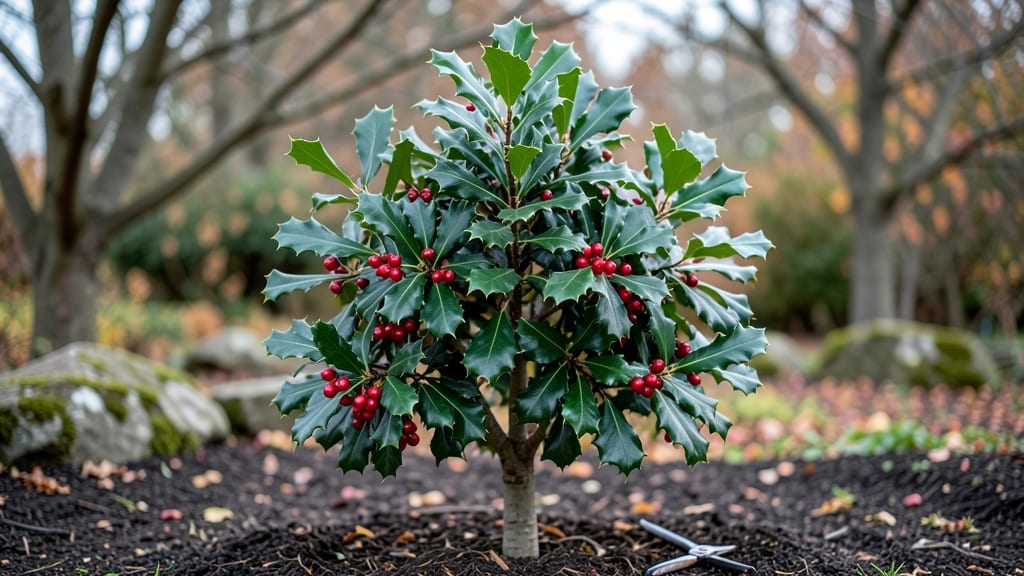
A holly tree looks like an evergreen shrub or small tree with glossy, spiky-edged leaves, bright red berries in winter, and smooth gray bark. Its dense, upright growth and sharp leaf margins make it instantly recognizable, especially in holiday decorations.
A holly tree's signature features—those glossy, sharp-edged leaves and clusters of vibrant red berries—make it a standout in any landscape. 🌿 The leaves vary in shape depending on the species, with some varieties like American holly having more pointed tips, while others like English holly show broader, slightly rounded edges.
What many people don't realize is that only female holly trees produce those iconic berries—male trees focus solely on pollen production, which is why you'll often find berryless holly trees in some gardens.
The bark plays a crucial role in identification too, especially as the tree matures. Young holly trees have smooth, gray bark that develops subtle ridges over time, creating a textured appearance that contrasts beautifully with the bright foliage.
This combination of leaf, berry, and bark makes holly trees a favorite for both natural settings and holiday-themed landscaping projects.
💡 In This Article
- Identifying Holly Tree Leaves, Berries, and Bark
- Best Ways to Spot a Holly Tree in Nature or Landscapes
Identifying holly tree leaves, berries, and bark
Holly tree leaves are typically elliptical to oblong with a leathery texture and spiny-toothed margins, measuring about 2-4 inches long and 1-2 inches wide. The upper surface is usually dark green and glossy, while the underside appears paler.
This leaf structure helps holly trees conserve water efficiently, with a waxy coating that reduces moisture loss—a key adaptation for their native woodlands. 💫
The berries are one of the most striking features, but here's the science: only female holly trees produce them, and they develop from pollinated flowers. These berries are typically bright red (though some varieties produce yellow or black berries), measuring about 1/4 to 1/2 inch in diameter.
They grow in clusters of 1-5 berries and remain on the tree throughout winter, providing a vital food source for birds. Male trees, on the other hand, produce small yellow flowers but no berries.
The bark starts smooth and gray in younger trees but develops shallow ridges as the tree matures, creating a subtle texture that contrasts with the vibrant foliage. This bark pattern is less pronounced than in oak trees but more defined than in boxwoods.
The smoothness helps holly trees resist pests and diseases, making them long-lived specimens in landscapes. 🌟
Seasonal changes are dramatic: in summer, holly leaves are lush and vibrant, while winter reveals their dark green coloration against snow. The berries' bright red hue stands out sharply against the gray bark and bare branches of surrounding trees.
This seasonal contrast is why holly is so popular in holiday decorations—it provides year-round visual interest. Compare this to yew trees, which have softer, needle-like leaves and fleshy, toxic red arils instead of true berries.
One common point of confusion is distinguishing holly from boxwood or yew. Boxwood leaves are opposite each other (rather than alternating) and have rounded edges, while yew leaves are flattened needles with a single vein.
Holly leaves always have multiple veins and spiny margins, making them instantly recognizable to trained eyes. The berries' presence in winter is another key differentiator—boxwood and yew don't produce true berries in the same way.
Here's a quick visual checklist for identification:
- Leaves: Glossy, spiny-edged, 2-4 inches long, alternating arrangement
- Berries: Bright red clusters (only on female trees), 1/4-1/2 inch diameter
- Bark: Smooth gray when young, develops subtle ridges with age
- Seasonal: Evergreen with winter berries, unlike deciduous trees