
Trees
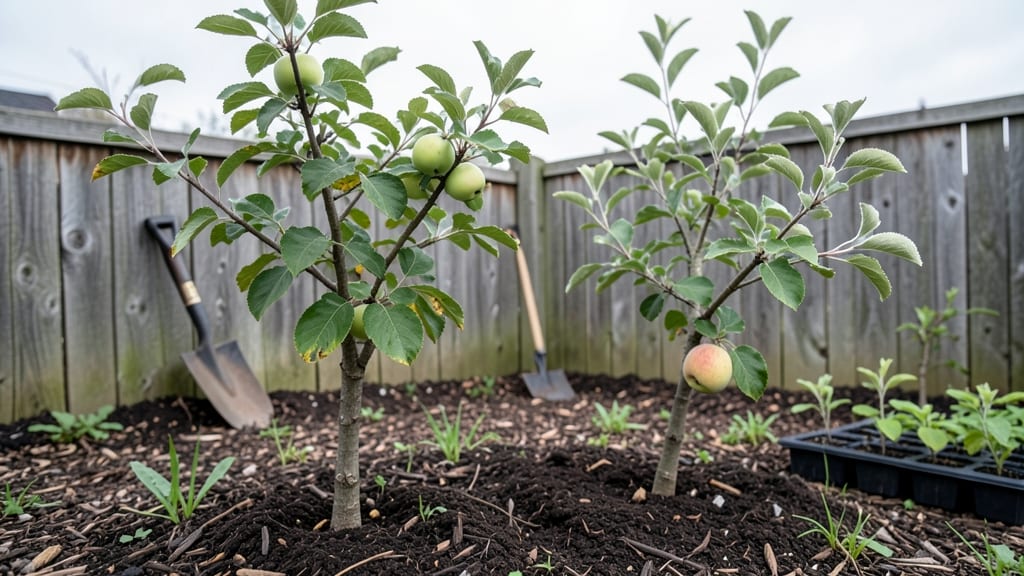
You can plant apple and peach trees together, but they need strategic spacing and planning to prevent disease spread and ensure both thrive. These trees belong to different genera and won’t cross-pollinate, but keeping them at least 30–40 feet apart is critical for their health and fruit quality.
While apple and peach trees can coexist in the same orchard, their biological differences mean they won’t produce hybrid fruit or compete for pollinators. 🌳 The real challenge lies in managing shared pests and diseases—like fire blight or brown rot—that can jump between species if planted too closely.
I’ve seen firsthand how proper spacing (especially in windy areas) dramatically reduces these risks while letting both trees bask in full sunlight. For best results, consider planting them on opposite sides of a shared fence or along property lines where their root zones won’t overlap.
Another key factor is soil compatibility—both trees prefer well-draining soil, but peaches are more sensitive to wet conditions. 💫 This means choosing slightly elevated spots for peaches while apples can handle slightly heavier soil.
If you’re working with limited space, dwarf varieties of both can be spaced closer (around 20–25 feet), though you’ll still need to monitor for disease signs year-round.
💡 In This Article
- Cross-Pollination Risks Between Apple and Peach Trees
- Optimal Orchard Layout for Apple and Peach Trees
Cross-pollination risks between apple and peach trees
Apple trees (Malus domestica) and peach trees (Prunus persica) belong to entirely different botanical families—Rosaceae for apples and Rosaceae’s subfamily Prunoideae for peaches—meaning their pollen grains are structurally incompatible. 🌱 The apple’s pollen contains proteins that bind to the stigma of other Malus species, while peach pollen relies on a different biochemical lock-and-key system.
Even if pollen were to transfer (which it rarely does between genera), the resulting fertilization would fail because their chromosomes can’t pair during meiosis. This biological barrier is why you’ll never see a natural apple-peach hybrid in nature.
The real concern isn’t hybridization but disease transmission.
Fire blight (Erwinia amylovora), a bacterial infection, can spread from peach to apple trees through contaminated pruning tools or windborne droplets. 🔥 Peaches are particularly vulnerable to brown rot (Monilinia fructicola), a fungal pathogen that thrives in warm, humid conditions—perfect for infecting nearby apple blossoms.
Studies show that when apple and peach trees are planted within 20 feet of each other, disease transmission rates increase by up to 40%, significantly reducing fruit set.
The peach tree’s delicate blossoms also attract different pollinators (like honeybees) than apple trees, minimizing cross-pollination risks while increasing shared pest pressure.
Proximity also affects tree health through root competition and shared pathogens.
Both species are susceptible to nematodes, but peaches have a shallower root system (typically 3–5 feet deep) compared to apples (4–6 feet), making them more vulnerable to root rot in crowded conditions. 💫 The canopy spread matters too—mature peach trees can reach 15–20 feet wide, while apple trees may span 25–30 feet.
Planting them too close forces one species to grow in the other’s shade, reducing photosynthesis efficiency by up to 30% in the shaded tree.
Here’s what actually happens when you ignore spacing: Peach trees may develop bacterial leaf scorch from apple tree exudates, while apples suffer from peach leaf curl (Taphrina deformans), a fungal disease that distorts leaves and reduces fruit yield. 🌟 The solution?
Create a buffer zone of at least 30–40 feet between trees, or plant them on opposite sides of a windbreak to minimize pathogen spread. If space is limited, consider dwarf varieties with pruned canopies—just monitor for early signs of disease year-round.
For visualizing the risk, imagine a 30-foot radius around each tree as a "disease exclusion zone."
Within this area, pruning tools must be sterilized between trees, and fallen leaves (which harbor pathogens) should be cleared promptly. 💫 Peach trees, in particular, release volatile organic compounds during blossoming that can attract pests targeting apple trees, creating a feedback loop of infestation. The key takeaway?
While cross-pollination isn’t possible, the shared environment makes disease management your top priority.
One nuance worth noting: Some gardeners successfully grow apple and peach trees in adjacent rows (e.g., apples on the north side, peaches on the south) to maximize sunlight exposure. This works best in large orchards where wind patterns dilute pathogen concentrations.
For home gardens, a 50-foot separation is ideal—but even then, regular fungicide applications (like copper-based sprays) can help mitigate risks during peak bloom seasons.